
The medieval hospital
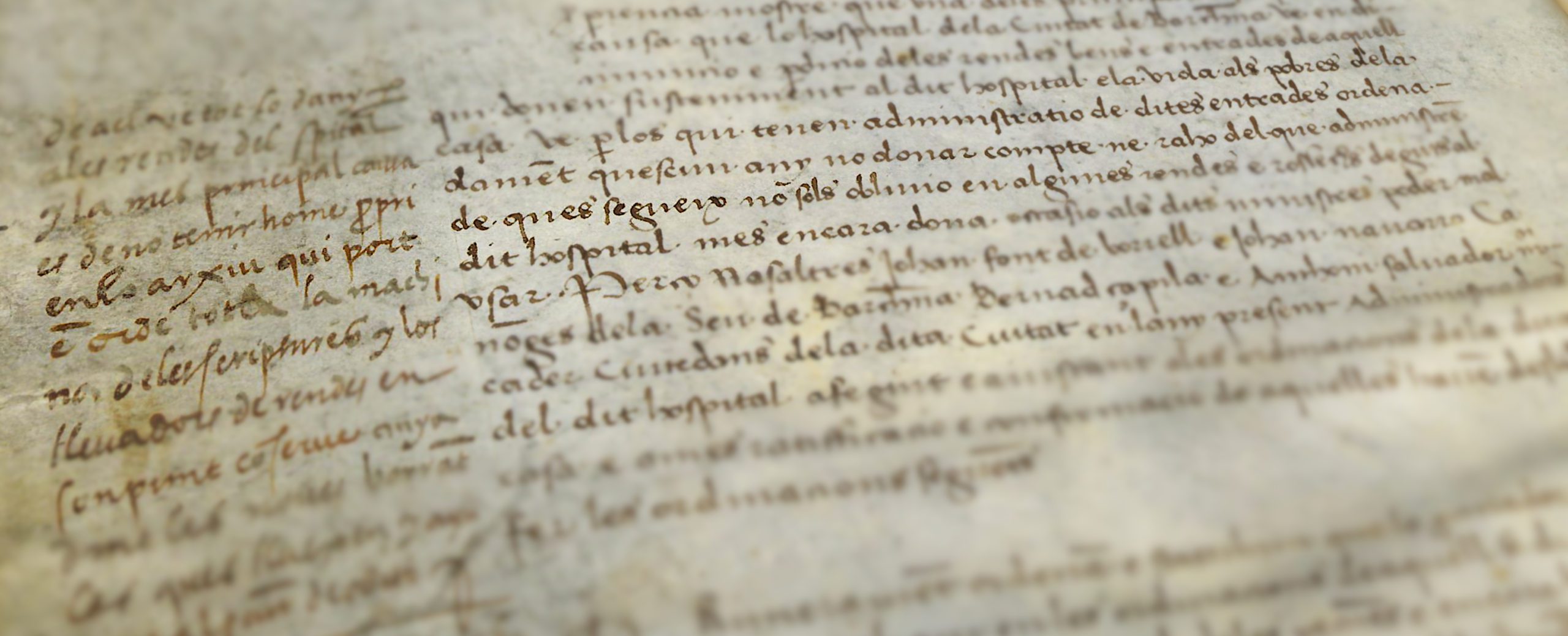
At the beginning of the 15th century, the city of Barcelona had six small hospitals: Hospital d’en Desvilar or de l’Almoina; Hospital d’en Marcús; Hospital del canonge Colom; Hospital del canonge Vilar or de Sant Macià; Hospital de Santa Eulàlia; and Hospital de Sant Llàtzer or de Santa Margarida. These institutions had been founded by religious orders or private individuals and, although they depended on the Consell de Cent or the Cathedral Chapter, almost all of their income came from charitable donations from the public.
The Old Hospital de la Santa Creu
At the beginning of 1401, the financial difficulties affecting many of these institutions led the Consell de Cent and the Cathedral Chapter to agree on the construction of a single new hospital resulting from the merger of the six healthcare centres. The aim was to improve the administration and management of their income. The decision was ratified on 5 September of that same year by a papal bull issued by Pope Benedict XIII, who authorised the foundation of the Hospital de la Santa Creu.
The new institution, one of the oldest hospitals in Europe and the world, was conceived as a large building with four rectangular wings, two storeys high and arranged around a courtyard, following the model of ecclesiastical cloisters. King Martin the Humane attended the laying of the building’s foundation stone on 13 February 1401. Construction was completed in 1450. Later, in the 17th century, the complex was extended with the construction of the Casa de Convalescència, while minor alterations were carried out during the 19th and early 20th centuries.
From its foundation, the Hospital de la Santa Creu was governed by the Molt Il·lustre Administració (MIA), a body comprising two canons and two lay citizens appointed respectively by the Cathedral Chapter and the Consell de Cent. The institution continued to depend on alms, donations and private bequests for its income. For this reason, two individuals, one cleric and one layperson, were directly responsible for overseeing its finances.
Over the years, the Hospital acquired new sources of funding thanks to various privileges granted by kings and popes. These included, for example, the right to inherit the property of people who died without a will or legitimate descendants (Alfonso the Magnanimous, 1418) and the privilege of theatrical performances (Philip II, 1587), which granted the Hospital the exclusive right to stage theatre performances in Barcelona.
For more than five centuries, the Hospital de la Santa Creu was the main hospital serving the city of Barcelona and its surrounding area. Its charitable work extended beyond caring for the sick, as until the end of the 19th century it also played an important role in sheltering and educating orphaned children.
Its contribution to the development of medicine was fundamental. The healthcare activity of the Hospital de la Santa Creu led to the creation of the Royal College of Surgery, the forerunner of the future Faculty of Medicine. From the 19th century onwards, the Hospital became the centre of significant teaching and scientific activity, establishing itself as a leading hospital comparable to the major European hospitals then being built across the continent.
By this time, however, the Gothic building in the Raval district was beginning to show signs of strain. After five centuries of uninterrupted activity, the Hospital de la Santa Creu could no longer meet the needs of Barcelona’s growing population or keep pace with constant advances in medicine. The construction of a new hospital had become essential.
The modernist hospital
The final years of activity at the Hospital de la Santa Creu coincided with Barcelona’s great urban transformation: the development of the Cerdà Plan and the construction of the Eixample district.
It was in this context of expansion beyond the city walls that Pau Gil i Serra, a Catalan banker living in Paris, died in 1896. In his will, Gil stipulated that his legacy should be used to build a new hospital in Barcelona. Among his instructions, he required the new institution to incorporate the most advanced technological, architectural and medical innovations and to be placed under the patronage of Saint Paul. This marked the birth of the Hospital de Sant Pau.
An agreement between the Board of the Hospital de la Santa Creu and Pau Gil’s executors made it possible to build the new hospital on land belonging to the Santa Creu institution, located between Gràcia, Horta, the Guinardó and Sant Martí de Provençals. The project was ultimately entrusted to Lluís Domènech i Montaner (1850-1923), one of the leading figures of Catalan Modernisme.
The work of Domènech i Montaner
The brilliant architect drew inspiration from Europe’s most modern hospitals when designing the complex. Based on hygienist principles, he created a hospital organised into separate pavilions surrounded by gardens and connected by a network of underground tunnels. Although Domènech designed a complex comprising 48 buildings, only 27 were ultimately constructed, of which just 16 followed his original modernist design.
Broadly speaking, Domènech created a square layout organised around two diagonal axes, one running north-south and the other east-west. Together they form a prominent cross, the emblem of the old Hospital de la Santa Creu, symbolically bringing together the history of hospital care in Barcelona and the allegorical values of the Middle Ages.
An unprecedented modernist building
Construction of the first ten buildings in the complex began in 1902, following an urban layout different from that of the Eixample. Each building was devoted to a different medical speciality. Natural light, good ventilation and the decoration of the interiors made the Hospital de la Santa Creu i Sant Pau a unique place in the world, introducing a new hospital model that recognised the importance of open spaces and sunlight in patient care.
After the architect’s death, his son, Pere Domènech i Roura, oversaw the final stage of the construction work. King Alfonso XIII officially inaugurated the Hospital de la Santa Creu i Sant Pau on 16 January 1930.
Over the years, as well as serving as a leading hospital for the public, Sant Pau has become a major landmark of Barcelona and Catalonia’s cultural and architectural heritage. It was declared a Historic-Artistic Monument in 1978 and a UNESCO World Heritage Site in 1997.
Growing healthcare demand and the structural deterioration of the buildings made it clear that the modernist complex no longer provided the conditions required to maintain the quality of medical care. Plans therefore began to be drawn up for a new, modern hospital suited to contemporary medical practice. Domènech i Montaner’s buildings had reached the end of their useful life as a hospital.
In autumn 2009, healthcare activity was transferred to a modern building located on the northern side of the complex. The Recinte Modernista thus began a new chapter. A rigorous restoration process has made it possible to showcase the work of Domènech i Montaner and transform Sant Pau into an internationally significant centre of knowledge and a new cultural landmark.
Learn more:
Blog de l’Hospital de la Santa Creu i Sant Pau
625 years of the Hospital de la Santa Creu i Sant Pau
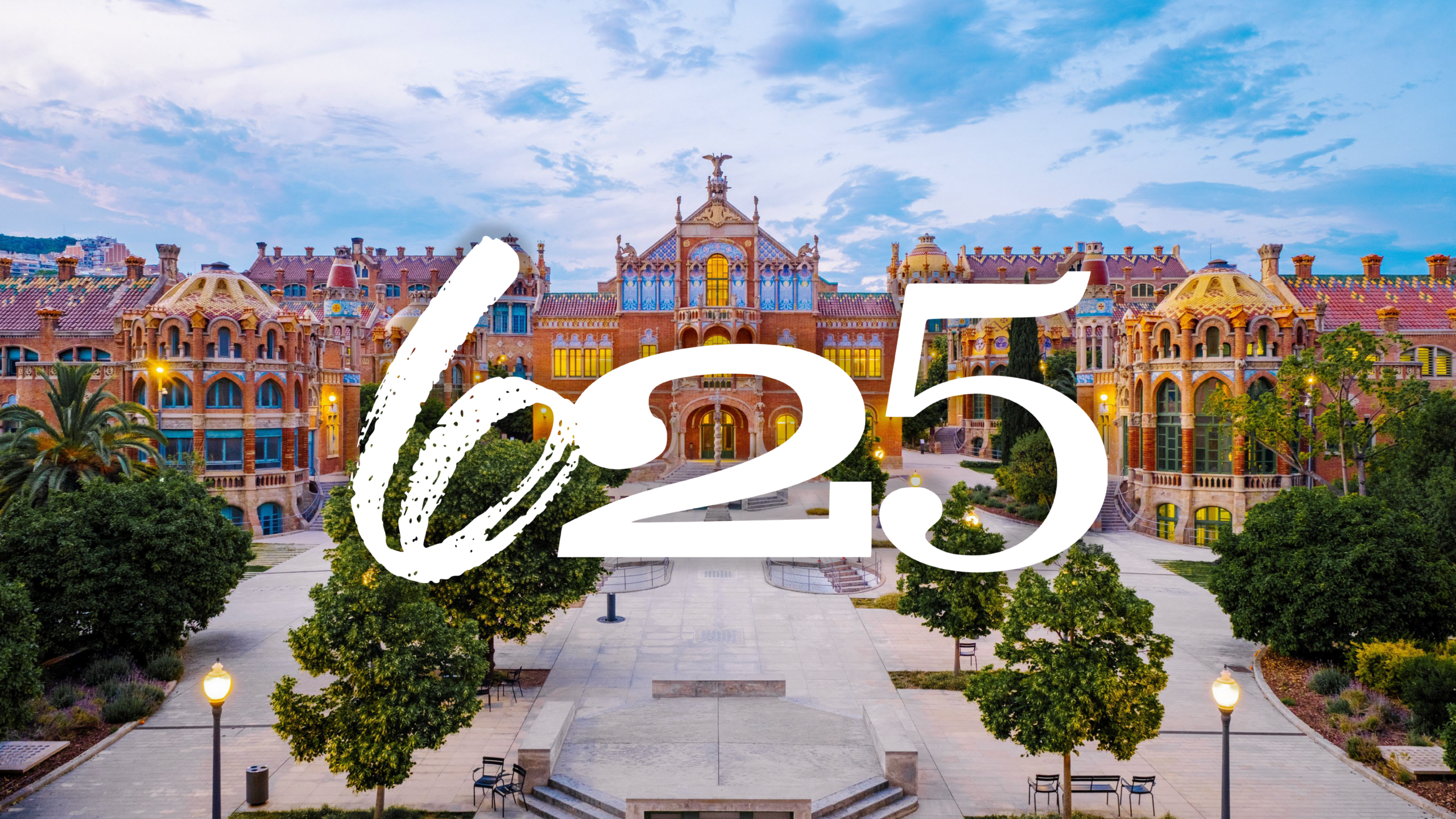
2026 marks the 625th anniversary of the founding of the Hospital de la Santa Creu, the historical origin of the present-day Hospital de la Santa Creu i Sant Pau. To mark this anniversary, the institution is promoting a programme of activities throughout the year combining institutional outreach, historical dissemination and public participation. With […]
SEE MORE
 Tickets


